
Critical materials
Today, global fossil fuel supply and demand is a topic of geopolitical concern. In the future, the attention may shift to the geopolitics of critical materials.

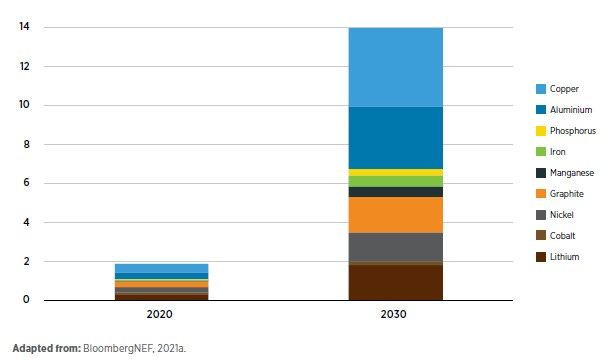
The supercharge demand for critical minerals
When it comes to minerals required for the energy transition, the mega challenge has been identified by the International Energy Agency (IEA) as follows:
The 2050 net-zero targets will supercharge the demand for critical minerals as the world moves from a ‘fuel intensive to a mineral intensive energy system.’ The result will likely be bottlenecks, shortages, and price spikes. An EV uses six times more minerals than conventional car; a wind turbine, nine times more minerals than a gas-powered plant!*
*From the book titled ‘The New Map: Energy, climate, and the clash of nations’
The misguided notion of recycling
Recycling can help avoid waste management problems, and it can help develop circular economy concepts on a timescale of decades or centuries.
Recycling can play a major role in the long-term, and can help reduce accumulation of toxic elements in the natural environment, it can do little to resolve scarcity of supply as critical materials in products currently used have a relatively long lifetime AND other critical materials might not be widely used before.
Recycling might be portrayed as a solution to the problem of access to critical materials; however, it cannot be the source of supply needed to build up the materials stock required for the global economy in the coming years.
The need for critical material ‘OPEC’ resemblance?
China produces more than 90% of all globally used rare earth metals, which are used in batteries, EVs and wind turbines to name a few. It also produces close to 90% of the world’s permanent magnet alloys. Are we shifting towards a central monopolized energy system? What are the risks and bottlenecks of such concentrated demand in certain geographic locations?
I wish I know the answer these questions. Nevertheless, the literature clearly shows that 11- to 26-fold expansion in rare earth production would be required for ambitious 2050 global wind power targets.
Today, various countries operate their own agencies that assess critical materials supply (USGS, Deutsche Rohstoffagentur, Joint Research Council, etc.), but an international body is lacking. The establishment of such a body could be considered.